
The 2030 AI Takeover: Why 2026 Is the Point of No Return
As of February 2026, the line between "software" and "staff" has officially blurred. We have crossed a threshold where AI is no longer a tool you use, but a coworker you manage. Current data reveals that 45% of enterprise software tasks are now handled autonomously by AI agents. This proves the "takeover" isn't a future threat. It is a present-day reality being orchestrated in the boardrooms of the world's most aggressive startups.
In my five years as a software engineer and product lead, I've watched this evolution unfold. We moved from simple autocomplete features to fully autonomous agentic workflows in what feels like a heartbeat. We are no longer asking if AI will take over. Instead, we are asking how humans will orchestrate the $5.8 trillion in value this shift has already unlocked.
Key Takeaways
- *Autonomy is the Standard: The Architect Era: Software engineering has shifted from manual coding to high-level system design and validation.
- Economic Surge: Generative AI has injected $5.8 trillion into the global economy over the last 24 months.
- Video Dominance: 90% of online video is projected to be AI-augmented by 2030, with 2026 serving as the tipping point.
- Orchestration Model: Success now depends on adopting a "Human-as-an-Orchestrator" mindset rather than resisting automation.
The Reality of the AI Takeover by 2030
The 2026 tipping point has redefined our definition of "work." When we discuss an AI takeover by 2030, we aren't talking about a sci-fi movie scenario. We are witnessing the total integration of intelligence into every layer of our digital infrastructure.
According to a 2026 survey of Fortune 500 CEOs, 88% now view "AI-Human Hybrid Teams" as their primary strategy for hitting growth targets. This isn't just about cutting costs. It is about scaling output in ways that were physically impossible three years ago.
At Narratives Media, we see this transition daily. Our clients don't just want "better videos." They want to maintain a consistent, scalable executive presence without the logistical nightmare of traditional filming. By bridging the gap between raw data and professional storytelling, we allow leaders to exist in multiple digital spaces at once.
The focus has shifted to augmenting human intelligence. We've moved past the fear phase and into the orchestration phase. The leaders who will win in 2030 are those building libraries of digital assets today—avatars, voice models, and proprietary datasets.
2026 Benchmarks: The Rise of Agentic Workflows
The most significant shift between 2023 and 2026 was the move from Generative AI to Agentic AI. Early models focused on answering queries. Today, 2026 agents set goals, use tools, and complete multi-step workflows independently.
Current GPT-5 class models have achieved "Professional Level" proficiency in 95% of standard white-collar licensing exams, including the Bar. This level of reasoning allows agents to function as junior-level employees in specialized fields.
For any modern startup, having a tech stack that isn't API-accessible by autonomous agents is a terminal mistake. If your software can't "talk" to an agent, you'll be bypassed by competitors who offer frictionless automation.
| Feature | 2023 Generative AI | 2026 Agentic AI |
|---|---|---|
| Primary Interaction | Prompt and Response | Goal-Based Delegation |
| Task Scope | Single Tasks (Write an email) | End-to-End (Run a campaign) |
| Autonomy | Human-Led | Human-Validated |
| Tool Usage | Experimental | Native API Integration |
| Context | Short-term Memory | Long-term Proprietary RAG |
Pro Tip: Audit your 2026 tech stack to ensure every tool has a robust API. Future-proofing requires that your software be "legible" to the AI agents that will eventually run your operations.
Software Engineering: From Coding to Architecture
As an engineer, my daily workflow has changed more in the last 24 months than in the previous decade. Today, 72% of software engineers use AI to write more than 60% of their production-grade code.
The focus has shifted from syntax to system architecture. We no longer spend hours debugging memory leaks in C++. Instead, we prompt an agent to refactor the module while we focus on how the microservice integrates into the broader ecosystem.
- Strategic Prompting: Writing the instruction set for a fleet of agents.
- Output Validation: Using automated testing to ensure AI "hallucinations" don't reach production.
- System Design: Mapping how various AI agents interact to solve complex business problems.
This evolution hasn't killed the profession. While 12 million roles were re-tasked globally in 2025, 14.5 million new roles in AI orchestration were created. The human-as-an-orchestrator manages a fleet of 100 agents, effectively turning a single developer into a full-scale engineering department.
The $5.8 Trillion Economic Impact
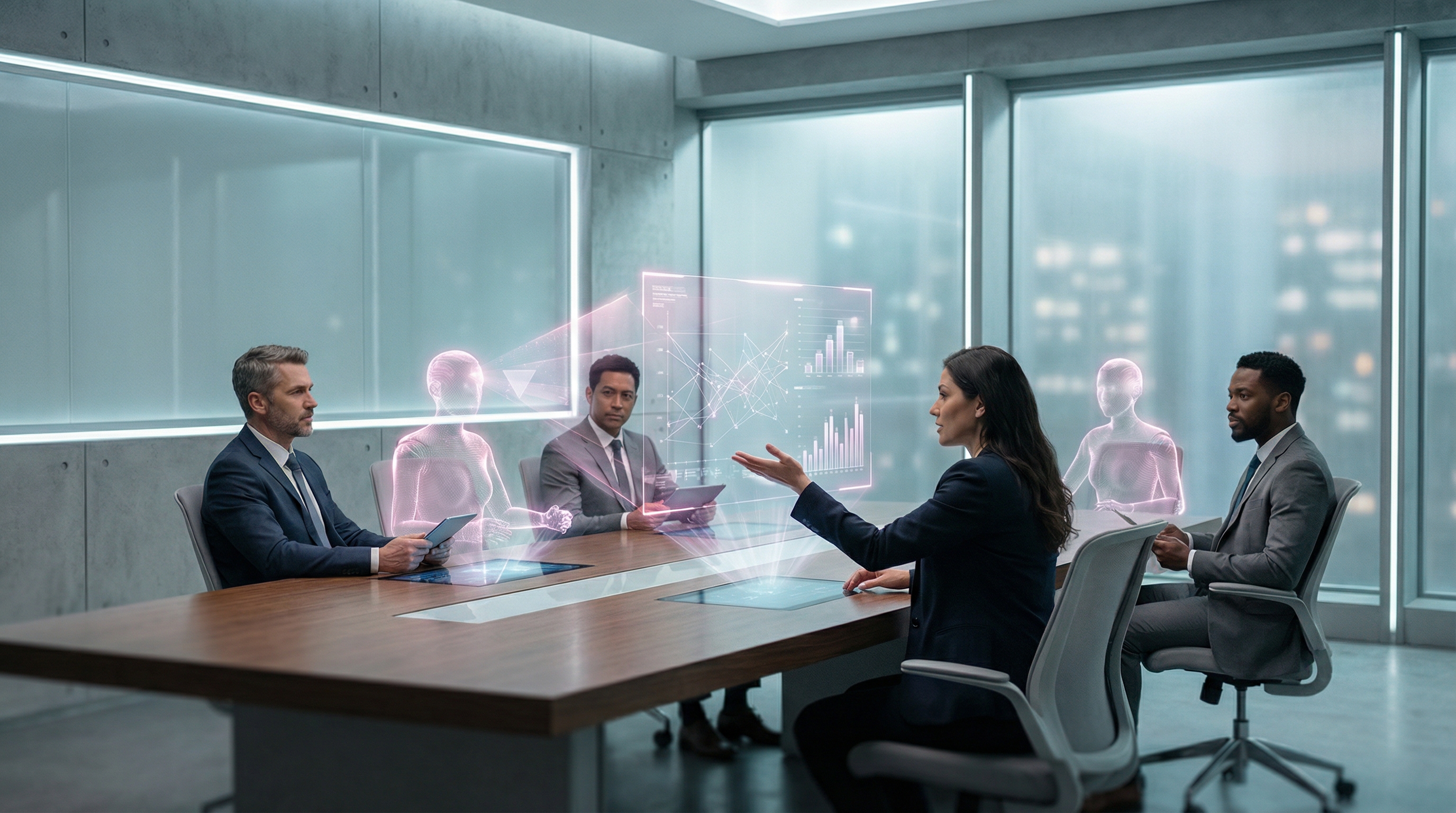
The financial markets have reacted with unprecedented speed. A 2026 McKinsey update reports that generative AI added $5.8 trillion in value to the global economy over the last two years.
This value isn't just theoretical. It is visible in the 35% year-over-year growth in institutional investment for autonomous content platforms. Investors are no longer betting on AI tools. They are betting on AI workers.
Think about marketing and sales. Traditionally, a high-conversion video pitch required a film crew, an editor, and a spokesperson. Today, platforms like Narratives Media allow teams to turn blog posts into lifelike video pitches in minutes.
The market size projection for 2030 has been revised upward to nearly $2 trillion for the AI sector itself. This economic engine is driven by one fact: AI-generated content can be personalized at a scale previously reserved for text-based emails.
Scaling Presence via Digital Twins
One of the most profound shifts in 2026 is the democratization of "Frictionless Presence." In the past, a founder's reach was limited by their physical ability to be on camera or on stage.
Digital twins have solved this bottleneck. By creating a high-fidelity digital twin of an executive, companies can maintain a consistent brand voice across LinkedIn and internal portals without the executive ever stepping foot in a studio.
At Narratives Media, we specialize in this studio-quality production. We use computer-vision mapping for realistic eye movement and micro-gestures. This ensures the avatar delivers messages with the same nuance as the original human.
Why executives are adopting digital twins:
- Scalability: Record once, then generate 1,000 personalized videos for 1,000 different leads.
- Consistency: The digital twin never has a bad day or a hoarse voice.
- Global Reach: Advanced text-to-speech allows the avatar to speak 40+ languages fluently.
Expert Insight: "2026 is the year we stopped talking about AI tools and started talking about AI coworkers. The psychological shift from using software to managing agents is the true precursor to 2030's total integration."
Strategic Risks of the 2030 Takeover

With such rapid adoption comes significant risk. The most dangerous pitfall is the "Innovation Stagnation Trap." Companies that use AI solely for cost-cutting often produce generic, uninspired content that fails to move the needle.
Furthermore, sophisticated 2026 audiences are becoming adept at spotting low-quality, non-curated AI content. If you remove the human-in-the-loop, you risk eroding the trust your brand has built over years.
Common mistakes to avoid:
- Treating AI as a Search Engine: It is an agent, not just a way to find info.
- Ignoring the Authenticity Gap: Using "uncanny valley" avatars that turn off viewers.
- Lack of Proprietary Context: Relying on public models rather than training private models on your internal data.
Trust is the most valuable currency in 2030. If your audience feels they are being talked to by a soulless bot, they will disengage. This is why a hybrid approach is essential: AI handles the labor, but human strategy drives the narrative.
The Small Model Revolution
The massive cloud-based models of 2023 faced a major hurdle: energy. Global demand for AI data centers increased by 160% since 2023, leading to a massive 2026 push for localized, "small-model" processing.
We are seeing a shift toward edge computing. Instead of sending every prompt to a massive server, your laptop or phone now runs a highly optimized model locally.
Benefits of localized processing:
- Privacy: Your company's proprietary data never leaves your local network.
- Speed: Latency is virtually eliminated, allowing for real-time AI interactions.
- **Cost:Essential components of a 2030 library:
- Custom Voice Models: Your unique tone and cadence, protected by encryption.
- Digital Avatars: High-fidelity models from Narratives Media that represent your leadership.
- Private LLM Context: A brain containing every white paper and strategy document your company has ever produced.
Start training your AI on internal documentation now. By the time 2030 arrives, your autonomous agents should have a decade of your company's wisdom to draw from. This proprietary context is what will separate the industry leaders from those using off-the-shelf tools.
Pro Tip: Implement a "Human-in-the-Loop" workflow for all AI-generated content. Use AI to do the 80% of the heavy lifting, but let a human expert handle the final 20% of creative polish.
FAQ

Will software engineering be a viable career in 2030?
Yes, but the role will be entirely redefined. Engineers will move away from writing manual syntax and toward system-level architecture and AI orchestration. You won't be a coder; you'll be a systems architect.
How do I create a professional AI avatar for my business?
You can utilize platforms like Narratives Media to record a baseline of your likeness and voice. Our team then processes this into a high-fidelity digital twin, allowing for automated, studio-quality production without future filming.
What are the ethical implications of AI-generated executive presence?
The primary concerns involve transparency and security. Ethical businesses in 2026 disclose AI use to their audience and use encrypted models to protect their executives' identities from unauthorized use.
Which industries are most resistant to the AI takeover?
Industries requiring high-tactile physical intervention, such as specialized surgery or manual trade crafts, remain resistant. However, even these are being augmented by AI diagnostic and planning tools.
How does agentic AI differ from 2023 generative AI?
While 2023 generative AI focused on creating content based on simple prompts, 2026 agentic AI can independently set goals, use external tools like APIs, and complete multi-step workflows without human intervention.
Conclusion
The AI takeover of 2030 is not a threat of obsolescence but an invitation to orchestration. By shifting your focus from manual execution to strategic oversight and building your digital asset library today, you can leverage the $5.8 trillion AI economy to your advantage.
The era of Frictionless Presence is here. You no longer have to choose between being productive and being visible. With the right strategy and the right partners, you can lead the revolution rather than being swept away by it.
Ready to lead the revolution? Partner with Narratives Media today to automate your video strategy and scale your brand with the power of 2026 agentic workflows. Visit narrativesmedia.com to book your strategy call.